
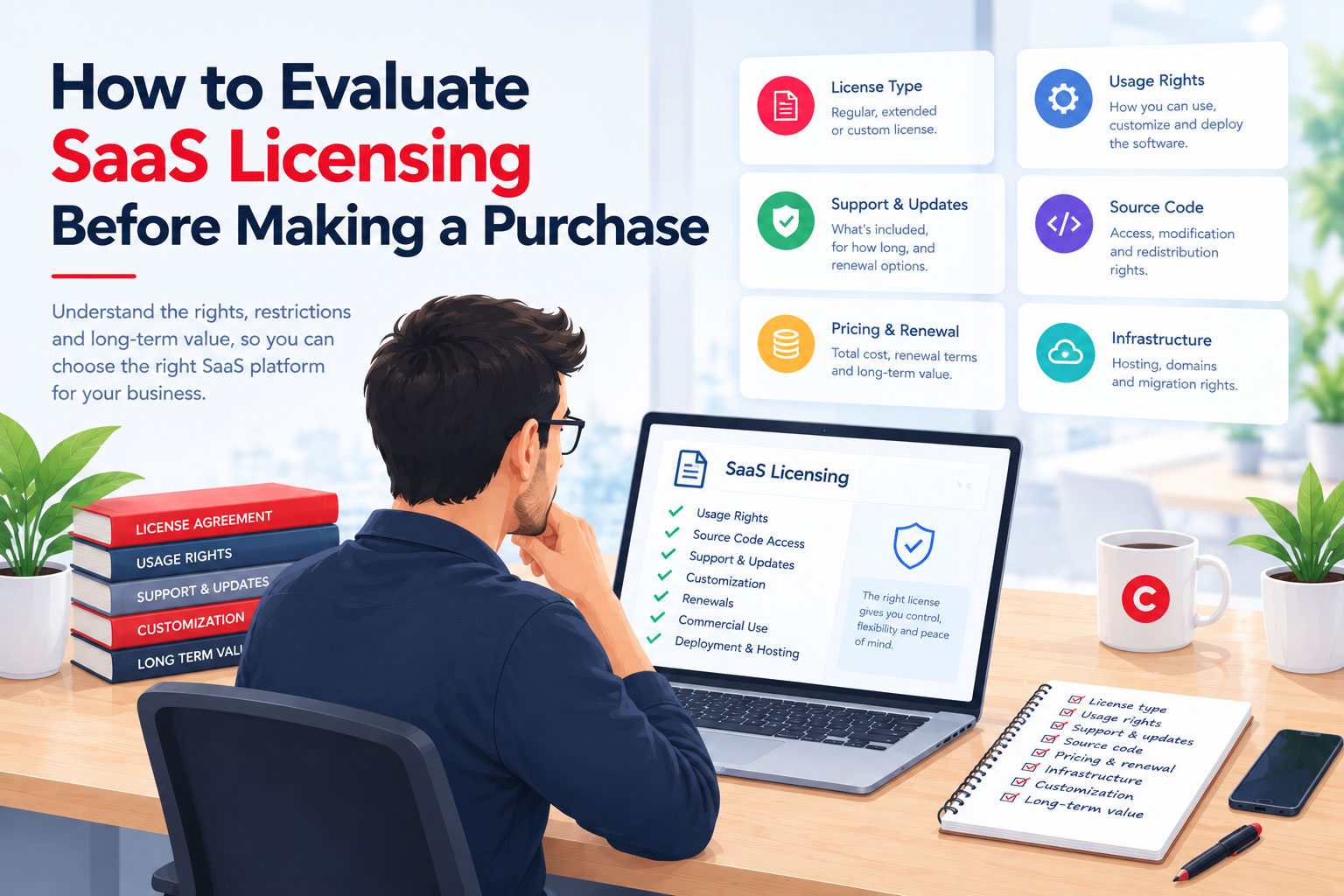
Choosing a SaaS platform is rarely just a technical decision. The software itself matters, but the license behind it can have an equally significant impact on how you build, operate, customize, and grow your business.
A platform may look ideal during a product demo, yet the licensing terms can determine whether you can modify the software, host it on your own infrastructure, serve multiple customers, continue using it after support expires, or build a commercial business around it.
For founders, agencies, developers, and business owners, understanding SaaS licensing before making a purchase helps prevent expensive surprises later. The goal is not simply to find software that works today. It is to understand exactly what you are acquiring and whether the license supports the business you intend to build.
Start by Understanding What You Are Actually Buying
The word "license" can mean very different things depending on the vendor and product. Some licenses provide access to a hosted service, while others provide the right to install and operate software on your own infrastructure.
Before evaluating features, establish the basic ownership and usage model:
- Is the software self-hosted or hosted by the vendor?
- Are you purchasing a license to use the software or subscribing to access a service?
- Can the software be installed on your own server?
- Can you modify the source code?
- Is the license tied to a specific domain, project, or installation?
- Can the platform be used commercially?
These questions establish the foundation for everything else. A platform can have impressive features, but if its license does not align with your intended use, those features may not provide the flexibility you need.
Look Closely at Usage Restrictions
Licensing terms often define where and how software can be used. This becomes particularly important when a SaaS platform is intended to support customers, multiple projects, or different business models.
Pay attention to restrictions involving:
- Number of installations
- Number of domains
- Number of projects
- Commercial versus personal use
- Client or customer usage
- Redistribution or resale
- White-label applications
- Modification of the source code
A license designed for a single internal project may not be suitable for an agency building solutions for clients. Likewise, a developer who intends to operate a commercial SaaS platform needs to understand whether customers can access the resulting service without creating licensing conflicts.
Clarity at this stage can save significant time later.
Understand Source Code Rights
For self-hosted SaaS platforms, source code access can be one of the most important considerations.
Access to source code provides the technical ability to inspect, customize, integrate, and extend the platform. However, access to code does not automatically mean unlimited rights to redistribute or resell that code.
These are separate concepts.
Before purchasing, determine what the license permits you to do with the source code:
- Modify existing functionality
- Create custom integrations
- Change the user interface
- Extend the platform with new features
- Connect external APIs and services
- Customize the platform for your business
A professional licensing agreement should make these boundaries understandable rather than leaving important questions open to interpretation.
Check Whether the License Supports Your Business Model
Your intended business model should influence your licensing decision from the beginning.
For example, a developer building an internal application has different requirements from an agency delivering a client solution. A company launching a public SaaS platform has different requirements again.
Consider how you plan to generate revenue:
- Will customers pay for access to your SaaS?
- Will you charge recurring subscriptions?
- Will you offer free and paid plans?
- Will you build multiple products around the platform?
- Will you customize the system for clients?
- Will you sell additional services alongside the software?
The licensing structure should accommodate the commercial model you actually intend to operate. Choosing a license first and discovering business restrictions later can create unnecessary complications.
Separate License Rights From Support
One of the most important distinctions to understand is the difference between a software license and ongoing support.
A license generally determines your rights to use the software. Support determines the assistance and services available from the vendor during a defined period.
These can include:
- Technical support
- Security updates
- Bug fixes
- New feature releases
- Compatibility improvements
- Installation assistance
- Documentation updates
Some vendors combine these services into a single purchase, while others separate the license from renewal-based support and updates.
Understanding the difference helps you evaluate the actual long-term value of the purchase instead of assuming that every future service is automatically included.
Examine Renewal Terms Carefully
Renewals are another area where buyers should look beyond the initial purchase price.
A renewal may provide continued access to support, updates, or other vendor services. It is important to understand what happens if you decide not to renew.
Questions worth asking include:
- Does the software continue operating after the support period ends?
- Does the license itself expire?
- Are future updates included only while support is active?
- Can support be renewed later if needed?
- Are renewal prices clearly defined?
- What happens to your existing installation if you do not renew?
Predictability matters. A licensing model should allow you to understand both your current rights and the potential future costs of maintaining the platform.
Review Domain and Installation Rules
Self-hosted platforms frequently use domain or installation-based licensing. This can be practical, but it should be clearly understood before deployment.
For example, you may need to know whether a license can be moved from a development environment to production, whether staging installations are permitted, and whether changing domains requires vendor assistance.
For businesses that expect to evolve, these details can become important operational considerations.
A useful licensing review should therefore cover the complete deployment lifecycle, from development and testing through production and future migration.
Consider Customization and Integrations
Modern SaaS businesses rarely operate in isolation. Payment gateways, analytics platforms, email services, CRM systems, AI APIs, storage providers, and other business tools often become part of the technology stack.
Your license should not create unnecessary barriers to these integrations.
Before purchasing, consider whether you can:
- Connect third-party APIs
- Customize existing workflows
- Add new integrations
- Modify database structures when necessary
- Extend the platform with custom modules
- Connect external payment or storage providers
Technical flexibility is valuable because your business requirements will likely change as your customer base grows.
Pay Attention to Transfer and Migration Rights
Businesses evolve. Domains change, infrastructure moves, and products sometimes change ownership.
That makes license transfer and migration provisions worth examining before committing to a platform.
Consider whether the license allows you to move the software to new infrastructure, change hosting providers, or migrate the application to another environment when circumstances require it.
Good infrastructure decisions should leave room for future decisions rather than locking your business into assumptions made on day one.
Read the License Instead of Relying on the Sales Page
Product pages are designed to communicate value. Licensing documents define rights and restrictions.
Those are two different purposes.
Before purchasing, review the actual license agreement and supporting documentation. If something important is unclear, ask the vendor directly and keep the response for your records.
Look specifically for language covering:
- Permitted usage
- Commercial activity
- Installation limits
- Modification rights
- Redistribution restrictions
- Client usage
- Support periods
- Renewals
- Updates
- Termination
A few minutes spent reviewing these details can provide considerably more clarity than relying exclusively on feature lists and promotional material.
Think About the Business Five Years From Now
The right license should support more than your immediate requirements.
Imagine your business after several years. You may have more customers, additional team members, new integrations, multiple revenue streams, and significantly more data. The platform that seemed sufficient for a small launch may become a critical part of your infrastructure.
Ask yourself:
- Will this license still support my business model as I grow?
- Will I retain control over my installation and data?
- Can I customize the system as requirements change?
- Can my team continue developing around the platform?
- Are future support and maintenance costs predictable?
Thinking beyond the initial purchase helps turn licensing from a legal formality into a genuine business consideration.
A Practical SaaS Licensing Checklist
Before making a purchase, create a simple checklist and confirm each point against the vendor's documentation.
- Usage: Confirm where and how the software can be used.
- Ownership: Understand what you own and what remains with the vendor.
- Source code: Verify your rights to inspect and modify the code.
- Commercial use: Confirm that your planned revenue model is permitted.
- Installations: Understand domain, server, project, and installation limits.
- Support: Know exactly what assistance is included and for how long.
- Updates: Determine how future releases and security improvements are handled.
- Renewals: Understand renewal pricing, terms, and consequences of non-renewal.
- Customization: Confirm that the platform can adapt to your workflows.
- Migration: Check whether you can move the installation when necessary.
This approach transforms licensing from something you simply accept into something you actively evaluate.
The Leadership Perspective
Strong technology decisions are rarely based on features alone. They consider control, flexibility, cost, risk, and long-term business objectives together.
SaaS licensing deserves the same level of attention.
A well-structured license can give your business the freedom to customize its platform, maintain control over its infrastructure, and build a sustainable operation around the software. A poorly understood license can introduce restrictions that only become visible after significant time and money have already been invested.
The goal is not to find the most complicated licensing arrangement or simply the cheapest option. It is to understand what you are purchasing and make sure those rights align with the business you want to build.
When the license, platform, and business model are aligned from the beginning, technology becomes a foundation for growth rather than a source of unnecessary limitations.