
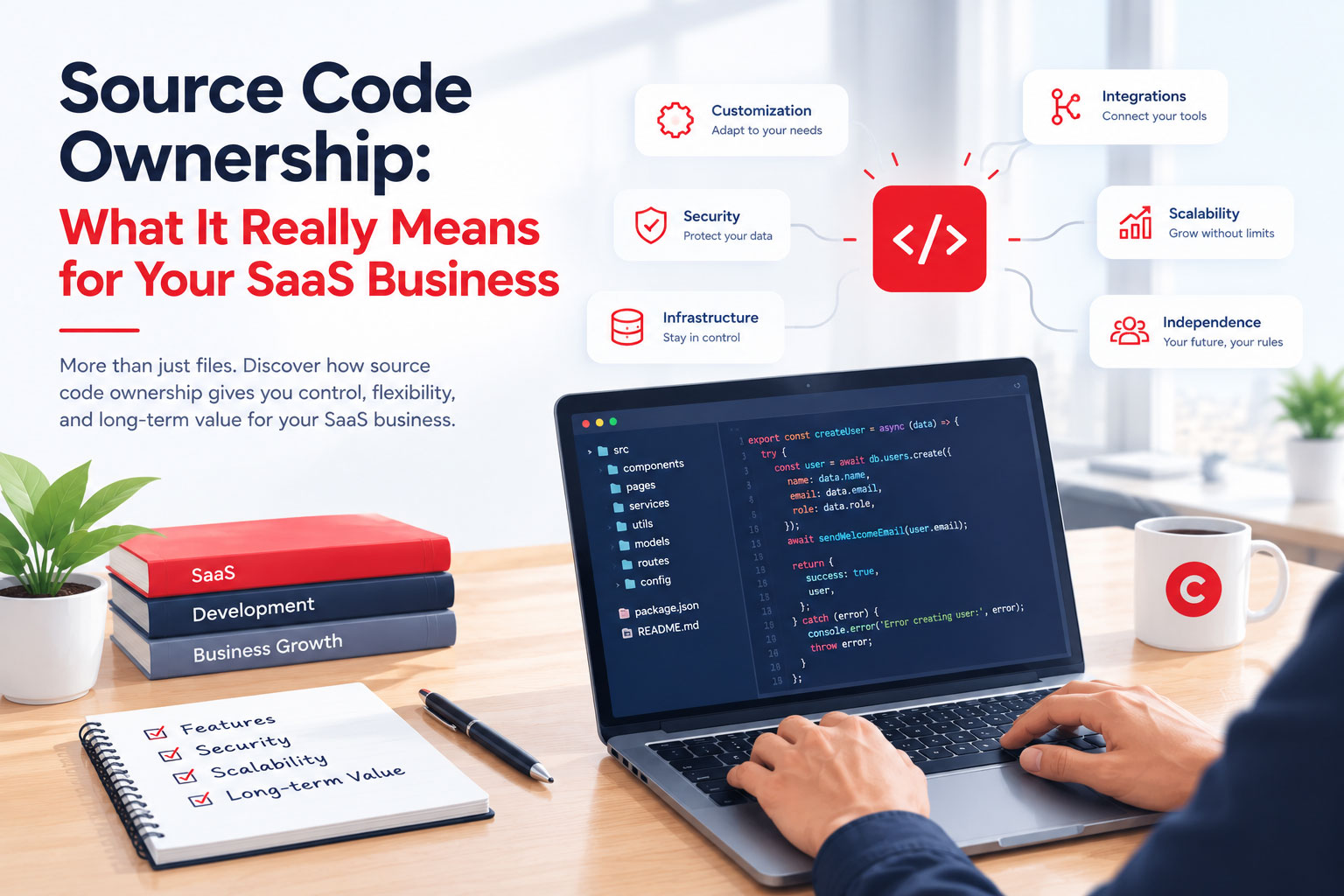
When choosing a SaaS platform, ownership is often presented as a simple question: Do you receive the source code or not?
In reality, source code ownership is much broader than having a folder of files on your server. It affects how you operate your business, how you customize your platform, how you manage customer data, and how much control you have over the future of your product.
For businesses building on self-hosted SaaS software, understanding what ownership actually provides is an important part of making a long-term investment.
True ownership means having the freedom to operate, adapt, maintain, and grow your platform according to your own business requirements.
Why Source Code Matters
Software is never completely finished. As your business grows, your requirements change. Customers request new capabilities, integrations become necessary, workflows evolve, and your business model may look very different a few years after launch.
When you have access to the source code, you have significantly more flexibility to respond to those changes.
Source code access can give your business the ability to:
- Customize features and workflows to match your operations
- Modify the user experience as your brand evolves
- Integrate additional services and business systems
- Work with your own developers or development partners
- Adapt the platform to new business requirements
- Maintain greater independence from a software vendor
This flexibility can become increasingly valuable as the platform becomes a central part of your business.
Ownership Creates Strategic Flexibility
A SaaS platform can begin as a simple business idea and gradually become a critical operating system for your company.
Your customer records, billing processes, subscriptions, products, documentation, analytics, and internal workflows may eventually depend on it. At that point, the ability to make meaningful changes becomes a strategic advantage.
Source code ownership gives you more options when those changes become necessary.
You are not limited to whatever functionality happens to be available at the moment. Instead, you can evaluate what the business needs and determine how the platform should evolve to support it.
That does not mean every business needs to modify its software constantly. In many cases, the greatest value comes from simply knowing that the option exists.
Self Hosted Does Not Automatically Mean Full Ownership
One of the most important distinctions to understand is that self hosting and source code ownership are not necessarily the same thing.
A platform can run on your server while still being subject to restrictions around licensing, modifications, usage, or redistribution.
Before purchasing a self-hosted SaaS solution, review the licensing terms carefully and understand:
- What rights are granted with the license
- Whether you receive the complete source code
- Whether modifications are permitted
- Whether you can hire another developer to customize the platform
- Whether there are restrictions on domains or installations
- What happens if you stop renewing support
- Which services remain available after the support period ends
The goal is not simply to find software that can be installed on your server. The goal is to understand exactly what control you are purchasing.
Ownership and Vendor Support Can Work Together
Some businesses assume that owning the source code means they must operate everything completely alone.
That is not necessarily the case.
A professional self-hosted platform can provide source code ownership while still offering optional support, updates, documentation, and technical assistance. This creates a useful balance between independence and professional continuity.
You retain control of your platform while having access to expertise when you need it.
This approach is particularly valuable for businesses that want to own their infrastructure without maintaining a large internal engineering team.
Understand the Difference Between Ownership and Updates
Source code ownership and ongoing updates solve different problems.
Ownership gives you control over the software you have licensed. Updates provide continued improvements, security fixes, compatibility changes, and new functionality from the original development team.
A strong software investment should make this distinction clear.
When evaluating a platform, look at both sides:
- Ownership: What control do you have over the software you purchased?
- Updates: How does the platform continue to evolve?
- Support: What assistance is available when you need it?
- Maintenance: How are compatibility and security issues addressed?
This gives you a much more realistic picture of the long-term value of the platform.
Your Infrastructure Should Support Your Independence
Owning source code is only one part of building an independent SaaS operation.
Your infrastructure also matters.
A self-hosted platform can allow you to maintain greater control over your server environment, databases, customer information, files, integrations, and operational processes.
That control can be especially important for businesses that need to establish their own brand and customer relationships without relying entirely on an external marketplace.
With the right foundation, your technology becomes an asset that supports the business rather than a dependency that limits it.
Think About the Business Five Years From Now
The easiest mistake when buying software is evaluating it only according to today's requirements.
A platform may appear perfect because it solves your immediate problem. But what happens when you have more customers, additional products, new payment requirements, different subscription models, or a larger support operation?
Long-term thinking changes the questions you ask.
Consider whether the platform can support:
- Additional products and services
- New subscription and pricing structures
- Third-party integrations
- Custom business workflows
- Growing customer and transaction volumes
- New team members and administrative roles
- Future changes to your business model
The best investment is rarely the platform with the longest feature list. It is the platform that gives your business enough flexibility to evolve.
Ownership Can Reduce Long Term Dependency
Every external service introduces some level of dependency.
That does not make external services bad. Payment gateways, cloud storage providers, analytics services, and other integrations are valuable parts of modern software businesses.
The important question is where your core business depends on systems that you cannot control.
When your primary SaaS platform is self-hosted and its source code is available to you, you have more options if your business requirements change.
You can bring in developers, move infrastructure, modify functionality, replace integrations, or build new capabilities without having to start the entire business again from the ground up.
What to Check Before You Buy
Before committing to a self-hosted SaaS platform, treat the license and ownership model as seriously as you evaluate the feature list.
A practical evaluation checklist includes:
- Source code access: Confirm exactly what is included.
- License rights: Understand what you are allowed to modify and operate.
- Installation rights: Check domain, project, or installation restrictions.
- Customization: Confirm that your developers can make permitted changes.
- Support terms: Know what assistance is included and what requires renewal.
- Update policy: Understand how new versions and security fixes are delivered.
- Data control: Confirm where customer data and business files are stored.
- Infrastructure requirements: Make sure the platform fits your hosting environment.
Taking time to answer these questions before purchasing can prevent expensive limitations later.
Ownership Is a Business Decision
Source code ownership is ultimately not just a technical consideration. It is a business decision.
When your SaaS platform becomes part of your revenue-generating operation, control over that platform can influence your ability to innovate, respond to customers, manage costs, and make strategic decisions.
That is why ownership should be evaluated alongside performance, security, pricing, support, scalability, and usability.
A platform that gives you control while providing a professional foundation can offer something more valuable than software alone: flexibility for the future.
A Smarter Way to Evaluate SaaS Ownership
The right question is not simply, "Do I own the source code?"
A better question is, "What can my business actually do because I own and control this platform?"
That shift in perspective helps separate genuine ownership from marketing language.
Look beyond the files. Examine the license, infrastructure, data control, customization rights, support model, update process, and long-term flexibility.
When those pieces work together, source code ownership becomes much more than technical access. It becomes part of the foundation that allows a SaaS business to operate independently, adapt confidently, and build for the long term.