
For many developers, marketplaces feel like the obvious starting point.
You build a script, publish it, and start making sales. Simple.
But at some point, usually after your first traction, you start noticing something uncomfortable:
- You’re not really building a business.
- You’re participating in someone else’s.
And that distinction changes everything.
The Hidden Cost of Marketplaces
Marketplaces are not the problem. They’re efficient distribution channels.
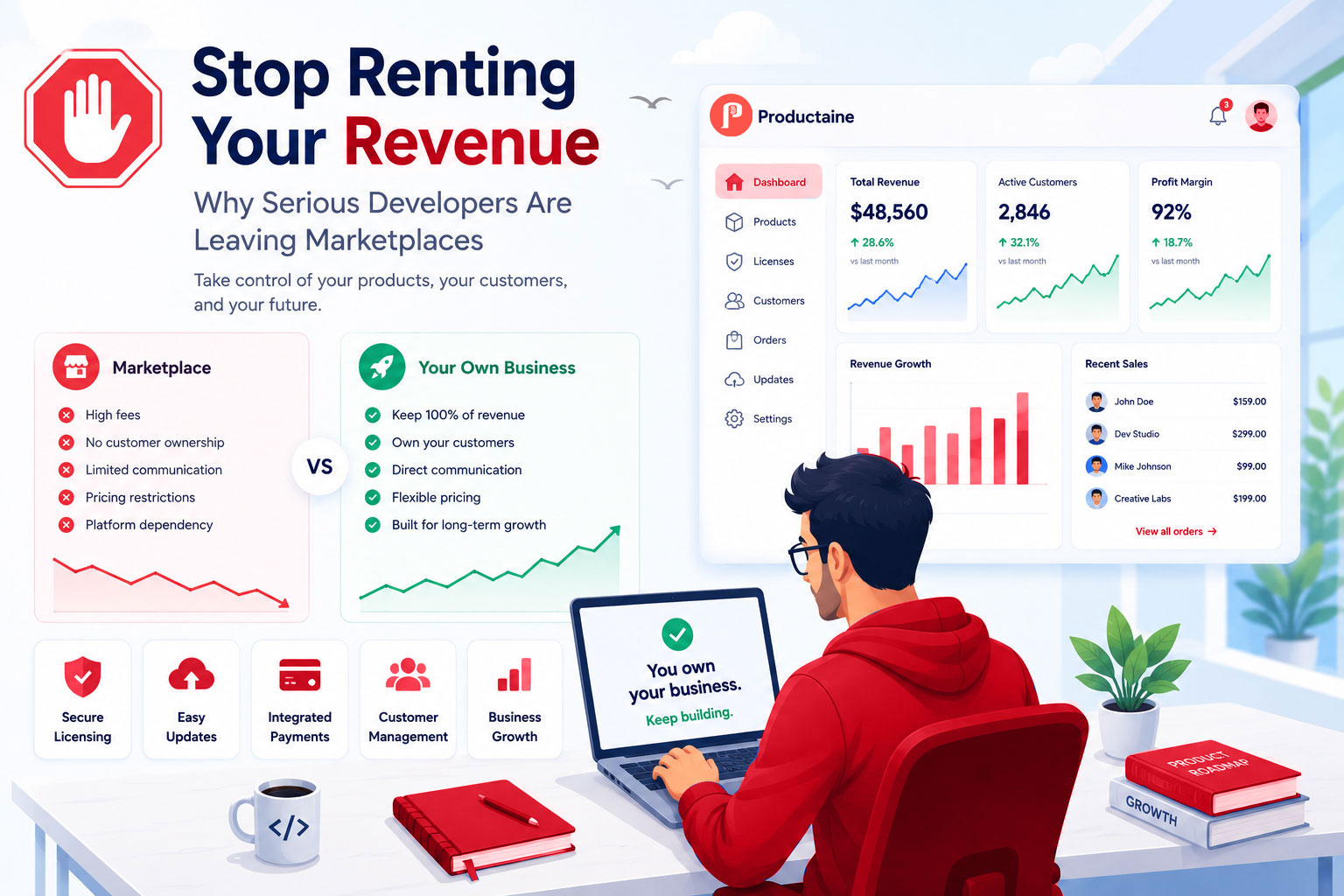
But they come with trade-offs that become harder to ignore as you grow:
- A significant percentage of every sale is gone
- You don’t truly own your customers
- Communication is limited or restricted
- Pricing flexibility is constrained
- Your growth depends on platform rules, not your strategy
Early on, this is acceptable.
Long term, it becomes a ceiling.
The Shift: From Seller to Owner
There’s a clear shift happening among experienced developers:
They stop optimizing for visibility and start optimizing for control.
Because control unlocks:
- Higher margins (no marketplace fees)
- Direct customer relationships
- Upsells, renewals, and long-term revenue
- Brand authority instead of product listings
This is where a simple product turns into a real business.
Where Most Developers Get Stuck
The decision to go independent is easy.
The execution is not.
Most developers run into the same friction:
- Licensing systems are built manually (or not at all)
- Updates are inconsistent and hard to distribute
- Payments, delivery, and access feel fragmented
- Customer management becomes chaotic
- Documentation lives in scattered tools
So instead of moving forward, they stall.
Not because the idea is wrong, but because the infrastructure is missing.
Infrastructure Is the Real Product
At scale, selling a script or plugin isn’t just about the code.
It’s about the system around it.
A real product business requires:
- Reliable licensing and validation
- Controlled product delivery
- Seamless updates
- Structured customer management
- Integrated payments and subscriptions
Without this, growth becomes fragile.
With it, growth becomes predictable.
A More Direct Approach
Instead of stitching together multiple tools or building everything from scratch, a more efficient approach is to start with infrastructure already designed for this exact use case.
That’s where Productaine comes in.
It’s built specifically for developers who sell:
- Scripts (PHP, JavaScript, etc.)
- Plugins and extensions
- SaaS products
- Source code
Not as a generic “all-in-one platform,” but as a focused system for selling and managing digital products independently.
What Changes When You Own the System
When the infrastructure is in place, the shift is immediate:
- You keep the full value of every sale
- You build direct relationships with buyers
- You control how and when you sell
- You can introduce upgrades, renewals, and bundles
- You stop depending on external algorithms
At that point, you’re no longer testing ideas.
You’re operating a business.
The Real Advantage Is Ownership
Most developers don’t struggle because their products are bad.
They struggle because they’re building on top of systems they don’t control.
If you’ve already validated that people will pay for what you’ve built, the next step isn’t more features.
It’s ownership.
If you're ready to move beyond marketplaces and build something you fully control, Productaine is designed to support that transition.