
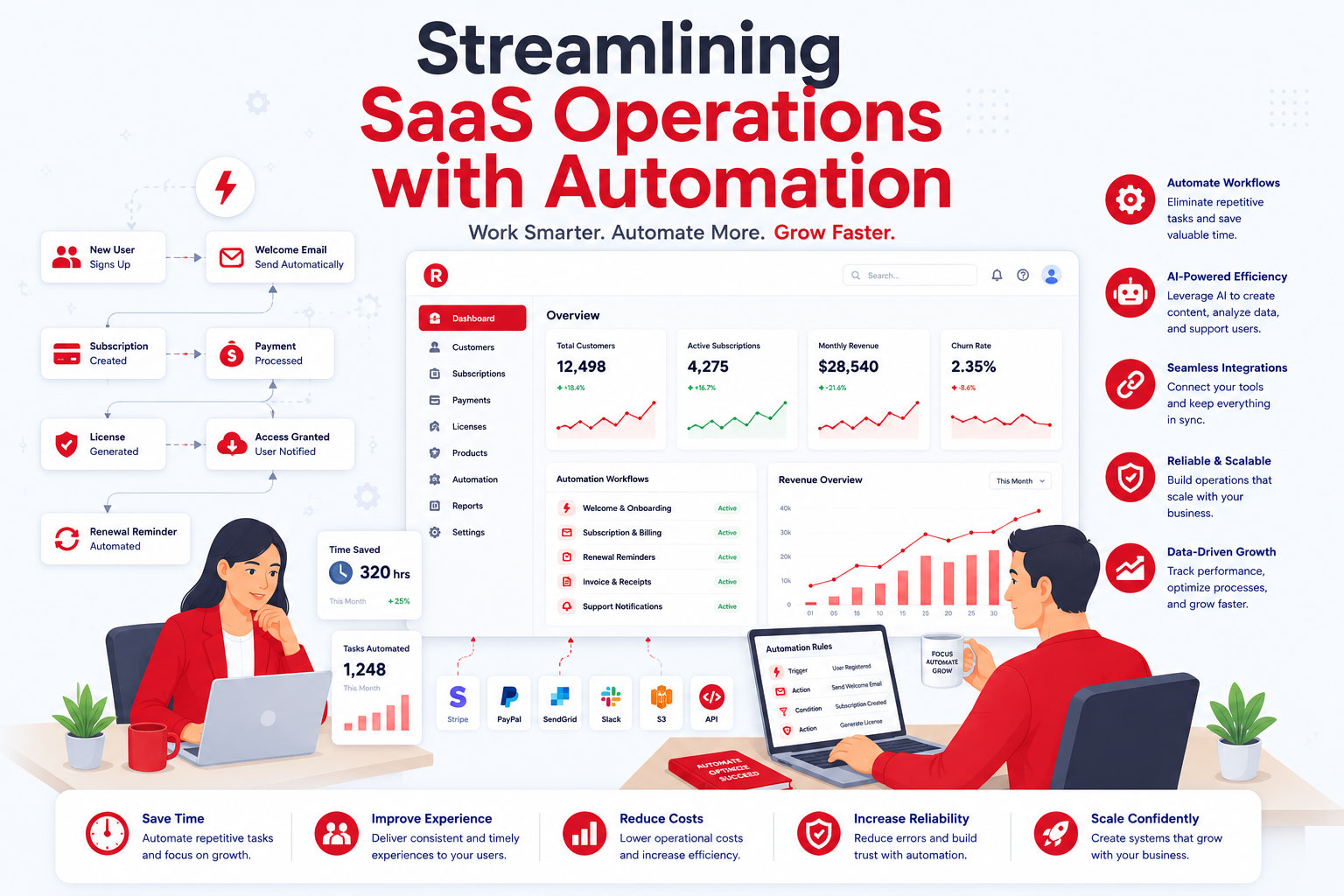
Automation has become one of the most valuable assets for modern SaaS businesses. As customer expectations continue to grow, founders and teams are expected to deliver faster support, maintain reliable operations, and continuously improve their products without dramatically increasing operational costs.
The goal of automation isn't to replace people. It's to eliminate repetitive work, reduce manual errors, and create more time for innovation, customer success, and business growth.
For self-hosted SaaS businesses, automation provides an opportunity to build efficient, scalable operations while maintaining complete control over your platform and data.
This guide explores practical ways to automate SaaS operations while creating a stronger foundation for sustainable growth.
Identify Processes That Create the Most Value
Before introducing automation, it's important to understand where it can have the greatest impact. The most effective automation strategies begin by identifying repetitive tasks that consume valuable time without directly contributing to customer value.
Common opportunities include:
- User onboarding and account provisioning.
- Subscription renewals and payment notifications.
- License generation and validation.
- Email communications and customer notifications.
- Routine reporting and administrative tasks.
- Software updates and deployment workflows.
Automating these activities allows your team to focus on strategic initiatives rather than routine administration.
Create Consistent Customer Experiences
Customers appreciate reliability just as much as innovation. Automation helps deliver consistent experiences throughout the customer journey, ensuring every interaction follows well-defined processes.
Examples include:
- Welcome emails immediately after registration.
- Automatic invoice generation and payment confirmations.
- License delivery following successful purchases.
- Password recovery and account verification workflows.
- Renewal reminders before subscriptions expire.
- Support ticket acknowledgments and status updates.
These automated interactions improve responsiveness while creating a more professional customer experience.
Use AI to Enhance Productivity
Artificial intelligence has expanded the possibilities of business automation well beyond traditional workflows.
Rather than replacing decision-making, AI can assist teams by accelerating routine tasks and providing valuable insights that support better business decisions.
Practical applications include:
- Generating product descriptions and marketing content.
- Summarizing customer inquiries.
- Assisting with documentation and knowledge bases.
- Creating onboarding materials.
- Supporting customer service with intelligent recommendations.
- Analyzing usage trends to identify opportunities for improvement.
When combined with human expertise, AI helps teams work more efficiently while maintaining quality and consistency.
Connect Your Business Systems
Automation becomes even more valuable when the systems your business depends on work together seamlessly.
Integrating billing platforms, CRM software, analytics tools, licensing systems, and customer management into connected workflows reduces duplicate work and improves data accuracy.
Consider automating processes such as:
- Synchronizing customer information across multiple platforms.
- Updating subscription status after successful payments.
- Generating reports from real-time business data.
- Triggering notifications when important events occur.
- Coordinating workflows between sales, support, and operations.
Connected systems create a more unified business environment where information flows naturally without constant manual intervention.
Monitor Automation and Continuously Improve
Automation is not a one-time implementation. As your business grows, your workflows should evolve alongside it.
Regularly review automated processes to ensure they continue supporting your operational goals.
Evaluate areas such as:
- Processing speed and reliability.
- Error rates and exception handling.
- Customer satisfaction and response times.
- Workflow efficiency.
- Integration performance.
- Opportunities for additional automation.
Continuous refinement ensures automation remains an asset rather than becoming another process to maintain.
Build Automation Around Your Business, Not the Other Way Around
Technology should adapt to your business, not force your business to adapt to technology.
A well-designed self-hosted SaaS platform allows you to automate workflows while maintaining full ownership of your infrastructure, customer relationships, and operational processes.
This flexibility enables businesses to introduce automation gradually, customize workflows as requirements evolve, and maintain complete visibility into every aspect of their operations.
The result is a platform that grows alongside your business rather than limiting it.
A Leadership Perspective on Automation
Successful SaaS businesses rarely grow by working harder alone. They grow by building systems that work smarter.
Automation helps organizations create predictable operations, improve service quality, and free talented teams to focus on innovation instead of repetitive administration.
When implemented thoughtfully, automation becomes more than a productivity tool. It becomes part of your competitive advantage.
The strongest SaaS businesses are built on efficient processes, reliable technology, and a commitment to continuously improving both the customer experience and internal operations.
By embracing automation as a long-term strategy, founders create businesses that are better prepared to scale, adapt, and deliver lasting value.