
Every successful software product begins with an idea. You identify a problem, build a solution, and release it into the world. The first customers arrive, positive feedback starts coming in, and the excitement of turning a side project into a real business becomes tangible.
Then the focus begins to shift.
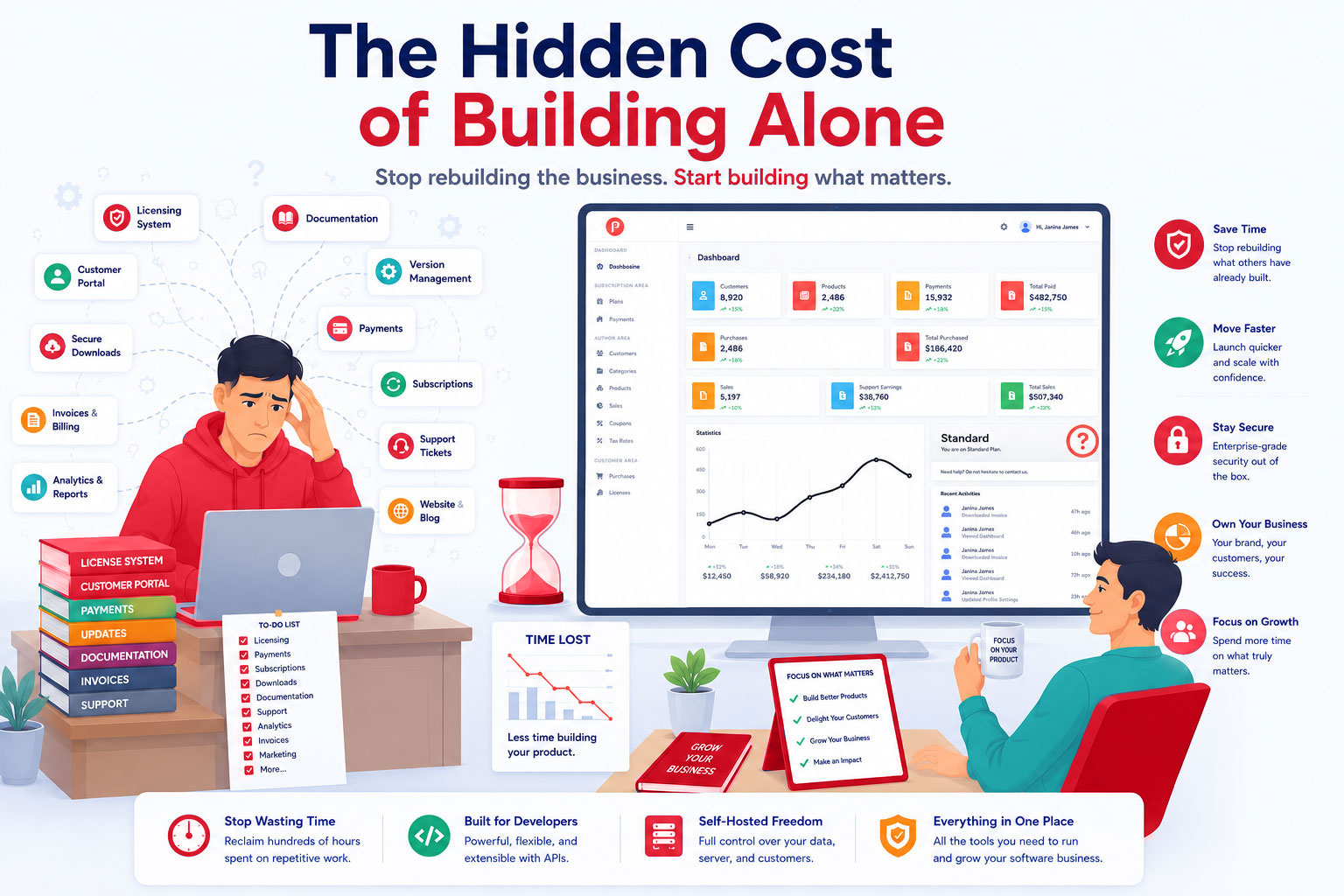
Customers don't just expect great software. They expect a professional experience around it. They need a secure way to download updates, manage licenses, access documentation, renew subscriptions, contact support, and retrieve invoices. Before long, you're no longer focused exclusively on your product—you've become responsible for the entire ecosystem that surrounds it.
This is a challenge that almost every independent software developer eventually encounters. Whether you're selling SaaS applications, commercial scripts, plugins, desktop software, or developer tools, the business infrastructure required to support those products often grows just as quickly as the software itself.
The surprising part is that, despite building completely different products, many developers end up solving remarkably similar business problems.
Every Software Business Faces Similar Operational Challenges
No two software products are identical, but the operational requirements behind them are often strikingly familiar. Once a product gains traction, developers typically need systems to manage customers, distribute updates, process payments, and maintain documentation.
It's a natural progression, but one that requires significant time and ongoing maintenance.
Common operational components include:
- Software licensing and activation
- Customer dashboards and account management
- Secure product downloads and version history
- Subscription billing and renewals
- Payment gateway integrations
- Documentation and knowledge bases
- Support ticket management
- Release notes and changelogs
- Marketing pages and product websites
- Analytics and business reporting
Each of these systems plays an important role in running a professional software business. Together, however, they represent a considerable investment of development time that often extends well beyond the original product itself.
The Opportunity Cost of Building Everything Yourself
Developers enjoy solving problems. It's one of the reasons software continues to evolve so quickly.
Building a licensing server, creating a customer portal, or designing a documentation system can be rewarding technical projects. They provide flexibility, complete ownership, and the satisfaction of understanding every layer of the stack.
The question isn't whether these systems can be built.
Most experienced developers absolutely can build them.
The more valuable question is whether they're the best place to invest your time.
Every month spent recreating common business infrastructure is a month not spent improving your product, responding to customer feedback, refining the user experience, or introducing features that differentiate your business.
Infrastructure is essential, but it's rarely the reason customers choose one product over another.
In many cases, your greatest competitive advantage isn't your licensing system or your payment workflow. It's the value your software delivers to the people who use it every day.
Building on Proven Foundations Is Part of Good Engineering
Modern software development has always embraced reuse.
Frameworks accelerate development. Libraries solve common problems. APIs connect specialized services. Cloud platforms simplify deployment. Rather than rebuilding everything from first principles, developers rely on proven technologies that allow them to focus on innovation.
The same philosophy can extend beyond application development and into the business infrastructure that supports commercial software.
Using an established platform for licensing, customer management, updates, or documentation doesn't reduce ownership. Instead, it allows developers to spend more time building the features that make their products unique.
Ownership isn't defined by writing every line of supporting infrastructure. It's defined by controlling your business, your customers, and your vision.
Growing Beyond Individual Projects
As software businesses mature, operational expectations continue to grow.
Customers expect seamless purchasing, secure downloads, automatic updates, accessible documentation, reliable billing, and responsive support. These experiences become part of the product itself and often influence customer satisfaction just as much as the software's technical capabilities.
Preparing for that growth requires more than adding new features. It requires building processes that remain reliable as your customer base expands.
Developers planning for long-term success often benefit from asking questions such as:
- Can this system support thousands of customers without major changes?
- How will updates be delivered consistently and securely?
- Is customer information organized and easy to manage?
- Can subscriptions, renewals, and payments scale with the business?
- Will documentation remain easy to maintain as the product evolves?
Thinking about these questions early creates a stronger operational foundation and reduces technical debt as the business grows.
Shared Infrastructure Can Strengthen Independent Businesses
The independent software community has never lacked creativity or technical expertise. Every day, developers build products that solve meaningful problems for businesses, creators, and consumers around the world.
What often consumes valuable time isn't product innovation—it's repeatedly building the same operational systems that nearly every software business eventually requires.
Imagine the collective effort invested across thousands of independent developers creating nearly identical customer portals, licensing servers, documentation platforms, update managers, and billing systems.
While each implementation is unique, the underlying business requirements remain remarkably consistent.
Shared infrastructure doesn't reduce creativity. It removes unnecessary repetition, allowing developers to focus their expertise where it delivers the greatest value.
Why Productaine Was Created
Productaine was built around a simple observation: independent software businesses shouldn't have to recreate the same operational foundation every time they launch a new product.
Instead of replacing the creativity involved in building software, it provides the infrastructure that supports selling and managing digital products from your own domain.
The platform brings together the capabilities many software businesses eventually need, including:
- Digital product licensing and activation
- Customer and purchase management
- Subscription billing and renewal workflows
- Secure downloads with version management
- Documentation, release notes, and changelogs
- Marketing pages, blogs, FAQs, and SEO tools
- AI-powered content workflows using modern language models
- REST APIs for products, licenses, customers, and payments
- Enterprise-grade security features and access controls
- Local and cloud-based storage options with full ownership
Everything operates from your own infrastructure, under your own brand, while maintaining direct relationships with your customers and complete control over your business.
The objective isn't to change how developers build software. It's to reduce the operational overhead that often slows software businesses as they grow.
Key Takeaways
- Every software business eventually requires operational infrastructure beyond the product itself.
- Building every supporting system independently offers flexibility but also carries significant opportunity costs.
- Proven infrastructure allows developers to focus more time on innovation and customer value.
- Long-term success depends on balancing product development with sustainable business operations.
- Owning your business doesn't require rebuilding every operational component from scratch.
Building What Matters Most
Software businesses succeed because they solve meaningful problems—not because they reinvent every operational system behind the scenes.
Strong infrastructure remains essential, but it should support innovation rather than compete with it for development time.
As your products mature, the goal shifts from simply shipping software to building a business that customers can rely on for years to come. Reliable operations, predictable customer experiences, and efficient workflows all contribute to that journey.
Whether you choose to build every component yourself or start from an established foundation, the most valuable investment you can make is the one that gives you more time to improve the products your customers depend on.
After all, your software is what makes your business unique. The infrastructure behind it should empower that vision—not distract from it.