
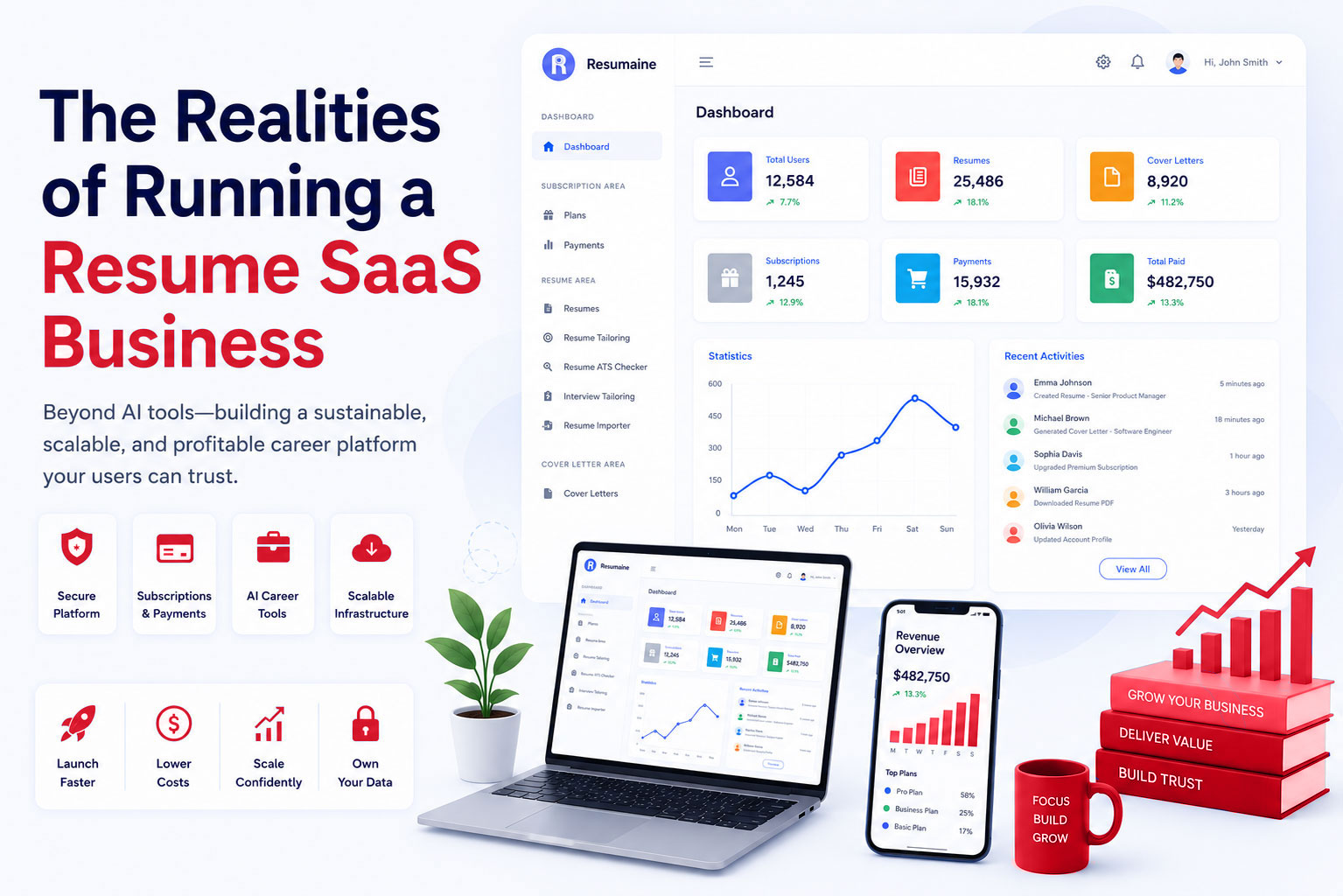
Launching a resume SaaS can begin with a simple idea. You recognize the growing demand for AI-powered career tools and envision a platform that helps people create professional resumes, compelling cover letters, and prepare confidently for their next opportunity.
Turning that vision into a successful business, however, involves much more than integrating an AI model.
Modern users expect a complete platform. They want secure accounts, subscription management, flexible payment options, downloadable invoices, personalized dashboards, reliable document generation, and a seamless experience from registration to renewal. What begins as a resume builder quickly evolves into a full SaaS operation with its own technical, operational, and business requirements.
Understanding those requirements early allows founders to build with confidence and create a platform that remains efficient as it grows.
Build on an Architecture That Supports Your Goals
Every technology stack offers unique strengths, and there is no universal solution for every business. The most important decision is choosing an architecture that aligns with your objectives, technical resources, and long-term vision.
As your platform grows, the software behind it should continue supporting your business without introducing unnecessary operational complexity. Infrastructure should help you move faster, simplify maintenance, and provide a stable foundation for future growth.
When evaluating any self-hosted SaaS platform, consider factors such as:
- Overall hosting and infrastructure requirements
- Deployment and update processes
- Scalability as your customer base expands
- Long-term maintenance requirements
- Availability of documentation and ongoing support
- Total operational cost over the lifetime of the platform
Looking beyond feature lists and considering the complete operational picture helps ensure your platform remains sustainable as your business evolves.
Keep Operational Complexity Proportional to Your Business
Every SaaS platform requires maintenance. The goal is not to eliminate complexity entirely but to ensure that every component contributes meaningful value.
Additional services, deployment pipelines, integrations, and background processes can provide powerful capabilities. At the same time, they also introduce additional responsibilities that require ongoing attention.
Before selecting a platform, ask practical questions such as:
- Will this architecture remain manageable as the business grows?
- Can updates be deployed efficiently?
- Does the infrastructure match the size of my business?
- Will ongoing maintenance require significant technical resources?
- Can my team focus primarily on customers instead of infrastructure?
Keeping operational complexity aligned with business needs allows teams to dedicate more time to product improvements, customer support, and sustainable growth.
Efficient Infrastructure Creates More Time for Innovation
Time is one of the most valuable resources available to any founder.
Every hour invested in maintaining servers, troubleshooting deployments, or managing infrastructure is an hour that cannot be invested in improving the customer experience, developing new features, creating educational content, or expanding your business.
An efficient platform allows technical teams to spend less time maintaining supporting systems and more time delivering value through the product itself.
Operational efficiency is not simply about reducing costs. It creates the freedom to focus on innovation, customer success, and long-term business development.
Evaluate the Platform Beyond Today's Requirements
Launching successfully is important, but building for long-term sustainability is even more valuable.
As your customer base grows, your platform should continue delivering consistent performance while supporting new features, larger datasets, AI-powered services, and increasing document generation without unnecessary operational overhead.
Consider whether your platform can:
- Support increasing numbers of concurrent users efficiently.
- Generate professional documents reliably.
- Integrate with cloud storage providers such as Amazon S3.
- Process AI workloads without affecting user experience.
- Remain easy to customize and maintain over time.
- Operate efficiently without requiring excessive infrastructure investment.
Thinking beyond launch day helps establish a stable operational foundation that supports predictable growth and recurring revenue.
A Practical Example
Resumaine was created around a simple philosophy: launching a professional career services platform should be straightforward, efficient, and fully under your control.
Rather than requiring founders to assemble multiple independent systems before serving their first customer, the platform brings together the capabilities commonly needed to operate a modern resume SaaS into a single self-hosted solution.
The objective is not to limit flexibility. Instead, it provides a dependable operational foundation that allows businesses to focus on delivering exceptional career services while maintaining complete ownership of their platform and customer relationships.
AI Career Services
- AI-powered resume creation and optimization
- Professional cover letter generation
- ATS compatibility analysis
- Interview preparation powered by OpenAI and Google Gemini
Business Operations
- Subscription management and recurring billing
- Support for multiple global payment gateways
- Invoices, coupons, taxation, and customer management
- Secure authentication and account management
Platform Management
- Native PDF generation
- Built-in blog and SEO tools
- Analytics integration
- Local and Amazon S3 cloud storage support
- Modern administration dashboard
Together, these capabilities provide a complete operational environment without requiring founders to build every supporting component themselves.
Best Practices When Choosing a Resume SaaS Platform
Selecting software is ultimately a strategic business decision. Looking beyond the initial feature list helps ensure the platform continues supporting your business as it grows.
- Review the complete hosting requirements before deployment.
- Understand how updates and maintenance are delivered.
- Evaluate the long-term operational costs, not just the purchase price.
- Prioritize platforms with clear documentation and reliable support.
- Choose software that aligns with your team's technical expertise.
- Ensure the platform provides flexibility for future integrations and expansion.
A thoughtful evaluation process leads to stronger operational decisions and greater confidence as your business evolves.
Build Your Business Before You Build Complexity
Technology choices influence much more than application performance. They shape operational costs, maintenance effort, scalability, and the amount of time your team can dedicate to serving customers.
The strongest SaaS businesses are built on reliable foundations that allow founders to focus on innovation rather than infrastructure.
By choosing a platform designed for efficiency, maintainability, and long-term sustainability, you create an environment where growth becomes more predictable and operations remain manageable.
A dependable foundation doesn't replace great ideas. It gives those ideas the opportunity to grow into a successful, lasting business.